
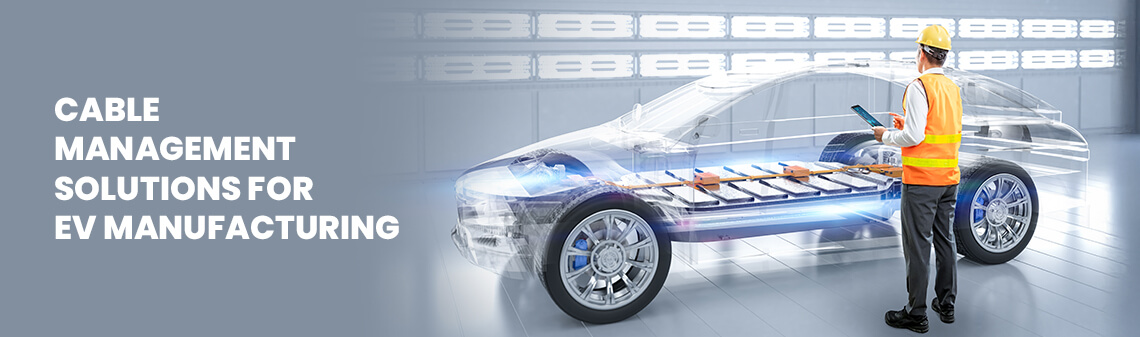
Cable Management Solutions in EV Manufacturing Facilities
December 11, 2025As EV plants scale up, the electrical load, sensor density, and automation footprint grow with them. Every station, from battery assembly to end-of-line testing, depends on clean, disciplined cable routing. When that structure is missing, downtime increases, safety margins shrink, and even small upgrades take longer than they should.
Strong cable management solutions in EV manufacturing aren’t cosmetic; they’re part of the plant’s operating backbone.
Why Cable Management Matters More in EV Plants?
EV production lines blend high-voltage systems with robotics, precision testing rigs, fast-moving conveyors, and sensitive communication circuits. With that mix, stray heat, contact, or interference can slow the entire line.
Good cable management keeps the routes predictable, reduces noise, and gives technicians safe access for repairs or changes. The cleaner the routing, the smoother the production rhythm.
What an EV-Ready Cable Management System Looks Like?
A proper system isn’t just a tray suspended overhead. It’s a coordinated network of trays, ducts, supports, fittings, and segregation rules tailored to each zone of the plant.
Elcon Global typically supplies:
- Perforated cable trays for mixed power and control runs.
- Wire mesh trays where drop-outs are frequent and automation changes quickly.
- Raceway cable trays for enclosed, impact-resistant pathways near battery lines or high-traffic zones.
- Stainless steel or coated finishes wherever heat, coolant, or aggressive cleaning cycles are expected.
- Dividers and partitions to keep HV, LV, data, and safety circuits from bleeding into each other.
Each component is chosen based on how that part of the line behaves, not just by catalogue preference.
How Routing Changes Across EV Production Zones?
- Battery Assembly and Module Lines -
These lines balance high-voltage feeds with delicate monitoring circuits. Enclosed raceways and perforated trays with dividers keep those paths controlled and shielded. - Robotic Welding and Body-In-White -
Heat, sparks, vibration, and motion are constant. Heavy-gauge perforated trays with robust supports handle the environment without losing form. - Powertrain and Inverter Testing -
Diagnostics depend on stable, interference-free signals. Wire mesh trays help with airflow and allow quick re-routing when tuning or calibration shifts. - Assembly Lines and AGV Pathways -
AGVs, conveyors, and floor movement demand tidy routing that won’t get snagged. Raceway systems and close-spaced supports keep cables protected. - End-Of-Line Testing -
This zone changes often. Teams prefer wire mesh trays because they can open a route, add a circuit, and close it again without stalling operations.
Elcon Global’s Approach to EV-Ready Infrastructure:
EV facilities push every detail harder, whether it is load, heat, cleanliness, or uptime. Elcon’s tray systems are built for this kind of environment:
- Trays are manufactured in mild steel, aluminium, and stainless steel 304/316.
- Finishes include pre-galvanised, hot-dip galvanised, and powder-coated.
- Complete accessory sets for every tray family: tees, reducers, bends, vertical transitions, drop-outs, couplers, and supports.
- ISO-aligned processes that keep dimensions consistent across the plant.
- A “one-vendor” philosophy so finishes, fittings, and supports match throughout the installation.
This keeps future expansions, model changes, and maintenance straightforward rather than chaotic.
How Cable Management Improves Line Efficiency?
When the routing is right, the whole plant benefits. Installers move faster. Maintenance teams find what they need without tracing cables for half an hour. Sensors and robots communicate reliably. Walkways stay clean for techs and AGVs.
Even audits move quickly because the layout is readable instead of improvised. Good cable management doesn’t just organise cables, it smoothens production.
Conclusion:
At its core, cable management in EV facilities is about control of heat, movement, interference, and growth. Wire mesh, perforated trays, and raceways each serve a specific role, and the most efficient EV plants use all three with intention. When the system is correctly designed, the plant becomes easier to operate, safer for teams, and quicker to scale as new models and technologies come in.
Planning an EV line or expanding an existing facility? Share your layout and Elcon will prepare a zone-wise tray schedule with the right mix of perforated, mesh, and raceway systems, built for real EV environments and ready for long-term growth.
FAQs:
1. What are cable management solutions specifically for EV manufacturing facilities?
These consist of tray, duct, support, and routing systems that effectively manage and protect power, data, and control cables throughout the EV assembly and production process.
2. Why is cable management fundamentally important in EV manufacturing?
Cable management ensures the safety of high voltage and delicate control circuits, minimises downtime, and provides reliable communication between all automated processes.
3. What types of cable management systems are commonly used in EV manufacturing?
Typically, perforated trays, wire mesh trays, raceways/cable ducts and dividers are utilised in various plant areas.
4. How do cable management solutions increase efficiency in EV manufacturing?
Cable management systems minimise failure, allow easy modifications and/or upgrades, improve ventilation, and improve maintenance practice.
5. What is the benefit of using cable trays and ducts in EV manufacturing?
Cable trays provide open routing for direct power and control circuits; cable ducts provide an enclosed, impact-resistant path in delicate areas or areas with heavy foot and transportation traffic.
6. How do cable management solutions minimise maintenance costs in EV manufacturing facilities?
Cable management solutions mitigate damage, keep circuits accessible, and limit tracing/circuit corrective action while servicing and upgrading the circuits.