
Ladder Type Cable Tray: A Complete Guide
August 04, 2026A ladder type cable tray is one of the most widely used cable management systems for supporting heavy power cables in industrial plants, commercial buildings, substations, and data centers. Its open ladder design provides excellent ventilation, high load capacity, and easy maintenance.
This guide walks through everything you need to know: what ladder trays are, how they're built, where they shine, how to install them properly, and how to choose the right one for your project.
What Is a Ladder Type Cable Tray?
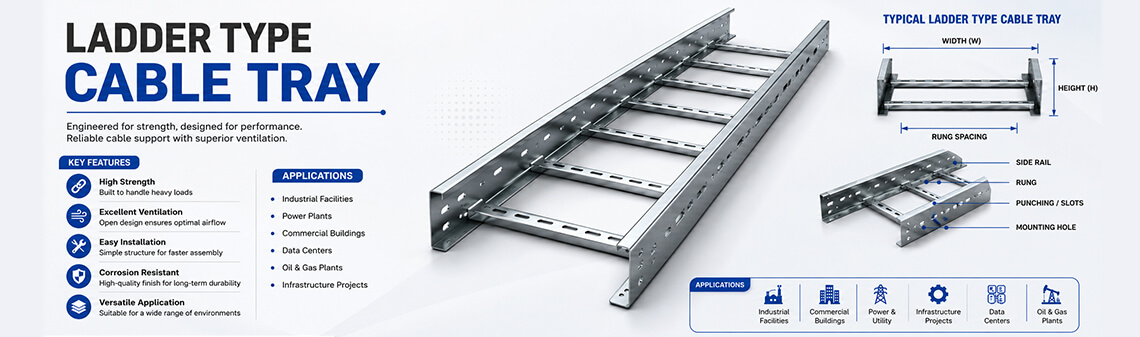
A ladder type cable tray is a cable support system made of two parallel longitudinal side rails connected by individual transverse rungs, spaced at regular intervals much like the rungs of a ladder, which is where the name comes from. Cables rest directly on these rungs rather than on a solid base.
This open, rung-based structure is what sets ladder trays apart from solid-bottom or perforated trays, and it's the source of most of their practical advantages.
Key Components:
- Side rails: The two structural members running the length of the tray, providing mechanical strength and support.
- Rungs: Cross-members welded or bolted between the side rails, spaced typically at 150 mm, 230 mm, or 300 mm intervals depending on load requirements.
- Splice plates: Connectors joining tray sections together to form a continuous run.
- Covers (optional): Solid, ventilated, or louvered covers added when extra protection from dust, sunlight, or falling debris is needed.
- Fittings: Bends, tees, crosses, reducers, and risers used to route the tray around obstacles and through elevation changes.
Why Choose a Ladder Type Cable Tray? Key Advantages
- Excellent ventilation The open rung design allows maximum air circulation around cables. This helps dissipate heat generated by current-carrying conductors, which is especially important for high-voltage power cables and heavily loaded circuits.
- Lower weight and material cost Compared to solid-bottom trays, ladder trays use less material for the same span, making them lighter and often more economical especially over long runs.
- Easy cable installation and maintenance Cables can be laid in, tied down, or pulled through easily. Because the tray is open, technicians can access cables at any point along the run for inspection, repair, or adding new circuits, without lifting a cover or disturbing the whole run.
- Strong load-bearing capacity over long spans The rigid side-rail-and-rung construction gives ladder trays excellent strength-to-weight performance, allowing wider spacing between support points than many other tray types.
- Good for cable derating Because ladder trays offer better heat dissipation than enclosed trays, engineers often apply less severe derating factors when calculating cable ampacity a meaningful benefit in power distribution design.
- Cost-effective for outdoor and industrial use Ladder trays handle wind loading well (due to their open structure) and are a common choice for outdoor pipe racks and industrial plant cabling.
Where Are Ladder Type Cable Trays Used?
- Power plants and substations - for high and medium voltage power cables
- Industrial and process plants (oil & gas, chemical, manufacturing) along pipe racks and between equipment
- Data centers - for main power feeders (often paired with basket trays for smaller data/comms cabling)
- Commercial and institutional buildings - in plant rooms, risers, and main distribution routes
- Outdoor installations - rooftop runs, between buildings, and along elevated structures
Ladder trays are generally the preferred choice wherever cables are large, heavy, or generate significant heat think medium and high voltage power cables rather than for delicate instrumentation or low-voltage data cabling, where basket or perforated trays are often more suitable.
Materials and Finishes:
Ladder cable trays are manufactured in several materials, chosen based on environment and budget:
| Material | Typical Use Case |
|---|---|
| Pre-galvanized steel (GI) | General indoor use, moderate corrosion protection |
| Hot-dip galvanized (HDG) steel | Outdoor and industrial environments needing higher corrosion resistance |
| Stainless steel (SS304/SS316) | Corrosive, chemical, coastal, or food/pharma environments |
| Aluminum | Lightweight applications, marine and offshore, non-magnetic requirements |
| FRP (Fiberglass Reinforced Plastic) | Highly corrosive chemical plants, non-conductive requirements |
Standard Sizes and Load Classes:
Ladder trays are typically available in widths ranging from 100 mm to 1200 mm, with standard depths of 50 mm, 75 mm, 100 mm, and 150 mm. Standard lengths are usually 2.5 m or 3 m per section.
Load classes (light, medium, heavy, extra heavy duty) are defined by relevant standards and depend on:
- Rung spacing
- Side rail depth and thickness
- Support span between hangers
Manufacturers typically publish load-span tables showing safe working loads (uniformly distributed load) at various support spacing intervals always check these before finalizing a design.
Relevant Standards:
Depending on the region, ladder cable trays are typically designed and tested to:
- NEMA VE 1 (North America) Metallic Cable Tray Systems
- NEMA FG 1 Fiberglass Cable Tray Systems
- IEC 61537 Cable management: Cable tray and cable ladder systems
- IS 2629 / IS 513 (India) related to galvanizing and sheet steel
- Local electrical codes (e.g., NEC in the US) for fill capacity, grounding, and clearance requirements
Always verify local code requirements, since fill ratios, support spacing, and grounding rules can vary by jurisdiction.
Installation Best Practices:
- Plan the route first - Map out the tray path considering cable pulls, expansion joints, and clearance from other services (pipes, ducts, HVAC).
- Support spacing matters - Follow the manufacturer's load-span table don't exceed recommended support intervals, especially for heavier cable loads.
- Maintain proper cable fill - Overfilling reduces ventilation benefits and can breach code-mandated fill ratios (commonly 50% for power cables, though this varies by code).
- Bond and ground the tray - Ladder trays should be electrically continuous and properly grounded per local code this is critical for personnel and equipment safety.
- Use proper fittings for direction changes - Avoid sharp bends that could stress cable insulation; use manufacturer-approved horizontal and vertical fittings.
- Separate power and signal cables - Where both power and low-voltage/signal cables are present, maintain adequate separation or use divider strips to reduce electromagnetic interference.
- Allow for expansion - In long runs or outdoor installations subject to temperature swings, install expansion joint splice plates at recommended intervals.
Ladder Tray vs. Other Cable Tray Types:
| Feature | Ladder Tray | Perforated Tray | Solid Bottom Tray | Wire Mesh/Basket Tray |
|---|---|---|---|---|
| Ventilation | Excellent | Good | Poor | Excellent |
| Weight | Moderate | Moderate | Heavy | Light |
| Best for | Power cables, long spans | Mixed use | Sensitive/shielded cables, dust protection | Light data/comms cables |
| Load capacity | High | Medium | Medium-High | Low-Medium |
| Cost | Moderate | Moderate | Higher | Lower |
Choosing the Right Ladder Tray for Your Project:
When specifying a ladder tray, consider:
- Cable type and load voltage, current, and weight of the cables it will carry
- Environment indoor/outdoor, corrosive exposure, temperature range
- Support span availability how far apart can support structures realistically be placed
- Future capacity leave room for cable additions; a common rule of thumb is designing for 40–50% fill to allow for future growth
- Local code compliance grounding, fill ratio, and fire-rating requirements
Final Thoughts:
Ladder type cable trays strike a practical balance between strength, ventilation, and ease of maintenance, which is why they remain the go-to choice for power cable routing in industrial plants, substations, and large commercial buildings. Getting the details right proper sizing, load-span calculations, material selection, and code-compliant installation ensures a cable management system that performs reliably for decades with minimal maintenance.
Whether you're designing a new industrial facility or upgrading an existing cable route, understanding these fundamentals will help you specify a ladder tray system that's safe, efficient, and built to last. Elcon is leading ladder type cable tray manufacturer in India. Visit us for any query.