
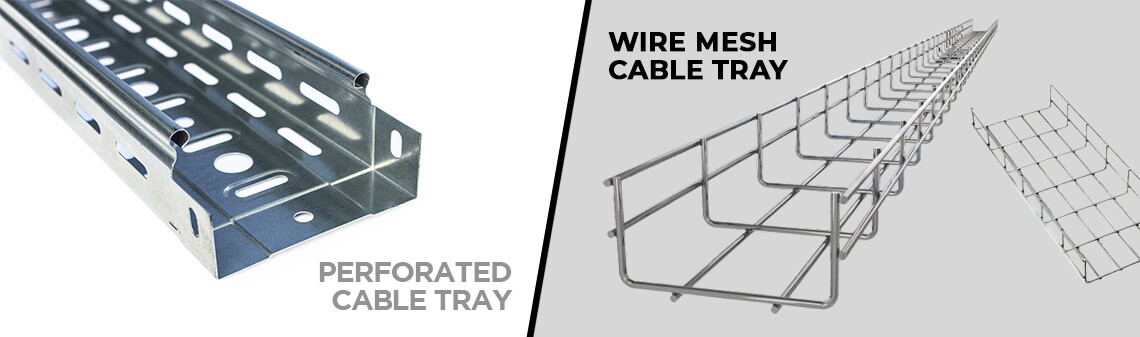
Wire Mesh Cable Trays vs. Perforated Cable Trays - Choosing the Right Fit for Your Project
October 08, 2025There isn’t one “best” tray for every run. The right call depends on what you’re carrying, how often things change, and how tidy you want the route to look.
This guide compares wire mesh cable trays vs. perforated cable trays, the way engineers actually choose on-site, by airflow, load, drop-outs, and maintenance.
First, Focus On the Job (Not the Product):
- Cable mix and headroom: List cable types, diameters, and growth for the next 12–18 months.
- MAC (Moves, Adds, and Changes) activity: If moves, adds, and changes are routine, the install must open up quickly.
- Heat and hygiene: Some zones want maximum ventilation; others prefer cleaner, shielded surfaces.
- Supports and spans: Check ceiling/wall structure before you lock tray widths and loads.
Quick Takeaway
- Wire mesh cable trays shines where agility matters. Dense drop-outs, frequent changes, tight turns, and light-to-medium loads.
- Perforated cable trays wins on defined routes. Steadier loads, longer spans, cleaner lines, and better side protection.
Mesh vs. Perforated: A Practical Comparison
| What you care about | Wire mesh cable trays | Perforated cable trays |
|---|---|---|
| Routing agility | Excellent. Cut, form, and tie in on the fly. | Good with standard fittings; looks neater end-to-end. |
| MAC speed | Very high. Ideal for IT/control teams. | Planned MACs through tees, reducers, and drop-outs. |
| Ventilation | High (open lattice). | High-moderate (vented base). |
| Cable protection | Lower. More exposed. | Higher. Sided tray with perforated base. |
| Typical loads | Light to medium (IT, control, low-voltage). | Medium to heavy (power + mixed services). |
| Aesthetics | Open, technical look. | Continuous, tidy runs. |
| Sweet spots | Data halls, office ceilings, control panels. | Plant floors, utility corridors, rooftops, risers. |
Where Each Tray Type Earns Its Keep:
Wire Mesh: Fast, Flexible, Data-Friendly
- Built for dense IT routes with frequent rack changes and short lead times.
- Quick trims and offsets mean fewer surprises during commissioning.
- Great for instrumentation/control where small-OD cables need tidy bundling and frequent access.
Perforated: Defined Routes, Stronger Shielding
- Suited for industrial corridors where loads are steady and drops are planned.
- Sidewalls protect bundles from casual contact and keep the visual line clean.
- Works well on longer spans with consistent support spacing and a planned accessory set.
Elcon Global’s Manufacturing Scope (For Both Families):
- Materials: Mild steel, stainless steel 304/316, and aluminium, picked as per load, hygiene, and environment.
- Finishes: Pre-galvanized, hot-dip galvanized, powder-coated, and other protective coatings matched to service life.
- Accessories:
- Wire mesh: splice kits, cantilever and trapeze supports, edge guards, drop-outs.
- Perforated: covers, coupler plates, tees, reducers, inside/outside/vertical bends, drop-outs, brackets, and hardware.
- Quality discipline: ISO-driven processes with a complete accessory ecosystem, so installers avoid on-site improvisation.
A Simple Selection Checklist:
- Width/height: Size for current fill plus growth; don’t crowd bend radii.
- Supports: Align spacing to spans and load class; confirm fixings early.
- Segregation: Use dividers when power and data share the route.
- Finish: Stainless for washdown/coastal, galvanized for plant floors and outdoors, coated systems for interiors.
- Access pattern: If MACs are frequent, lean wire mesh. If routes are fixed, lean perforated.
Common Mistakes to Avoid:
| Mistake | Why it’s a problem | Fix |
|---|---|---|
| Overfilling trays | Traps heat, strains cables, complicates handling | Respect the fill limits and bend radii |
| Skipping dividers | Causes electrical noise and requires rework on data lines | Segregate power and data from day one |
| Mixed finishes | Accelerates galvanic corrosion and hardware failures | Keep tray, fittings, and hardware finish-compatible |
| Treating mesh like a ladder on long spans | Excess deflection and poor support | Tighten support spacing or switch tray type |
How Elcon Helps You Land the Decision?
The choice isn’t mesh vs. perforated in the abstract; it’s what each zone demands. Use mesh where change is constant and access speed matters; use perforated where routes are defined, spans are longer, and protection is a priority. The cleanest projects use both, with one logic across the site.
Still deciding between wire mesh and perforated? Share your layout. Elcon Global, best cable tray manufacturer in India will map zones tray-by-tray, size spans and supports, and recommend finishes that hold up in your environment. So you get one clear schedule and zero guesswork.
FAQs
1. What is the difference between wire mesh and perforated cable trays?
Wire mesh is an open lattice for flexible routing and quick changes; perforated is a sided tray with a vented base for cleaner lines and better cable protection.
2. Which cable tray is better for data centers?
Wire mesh usually fits data halls thanks to high ventilation and fast MAC work, while perforated works for backbone routes where added shielding and neat lines are preferred.
3. Are perforated cable trays suitable for heavy-duty industrial use?
Yes. Perforated trays are adequate for medium to heavy loads, planned drops, and span longer distances typical of plant floors.
4. Can Elcon Global supply both wire mesh and perforated trays?
Yes. Both families are produced in-house with matched fittings, supports, and hardware.
5. What materials are used in Elcon Global’s cable trays?
Mild steel, stainless steel 304/316, and aluminum with pre-galvanized, hot-dip galvanized, or powder-coated surfaces.
6. Why should I choose Elcon Global for cable tray solutions?
You get to choose either tray option, accessories are consistent with ISO quality, and you have one partner from design to handover.