
Types of Cable Trays: Ladder, Perforated, Wire Mesh, Solid Bottom & Channel
January 10, 2025What is a cable tray?
A cable tray is a rigid support system that carries insulated power, control and data cables along a route in buildings and industrial plants. Unlike conduit or a raceway, most trays are open or ventilated, so cables stay cool and easy to inspect.
What are the main types of cable trays?
The three most common are ladder (heavy power cables, long spans), perforated (medium loads with ventilation) and wire mesh (light data cables, easy on-site changes). Solid bottom, channel and single-rail trays complete the six construction types recognised in NEMA VE 1. Material (galvanized, stainless steel, aluminium, FRP) is a separate choice, covered below.
Cable Tray Types at a Glance
| Type | Structure | Best for | Load capacity | Ventilation | Typical width |
|---|---|---|---|---|---|
| Ladder | Two side rails joined by rungs | Heavy power cables, long runs | Very high | Excellent | 150–1200 mm |
| Perforated | Base with punched holes or slots, side rails | Power and control cables | Medium to high | Good | 50–1000 mm |
| Wire mesh (basket) | Welded steel wire grid | Data, telecom, light control cables | Low to medium | Very high | 50–600 mm |
| Solid bottom | Unperforated base, side rails | Sensitive cables, dust or EMI control | High | Poor | 100–600 mm |
| Channel | Compact U-shaped section | Small cable bundles, tight spaces | Low | Limited | 50–300 mm |
The 6 Main Types of Cable Trays
1. Ladder Cable Tray
A ladder tray has two longitudinal side rails connected by rungs. The open design gives maximum airflow, and cables can be tied or clamped to the rungs from above or below. It is the standard choice for heavy power cables and long support spans.
- Use it when: cable weight is high, runs are long, or you need easy access, as in industrial plants, oil and gas, and power distribution.
- Avoid it when: small-diameter cables could sag between rungs, or the route needs dust protection without a cover.
- Typical size: width 150–1200 mm, side height 50–150 mm, length 3–6 m.
See Elcon's ladder cable trays.
2. Perforated Cable Tray
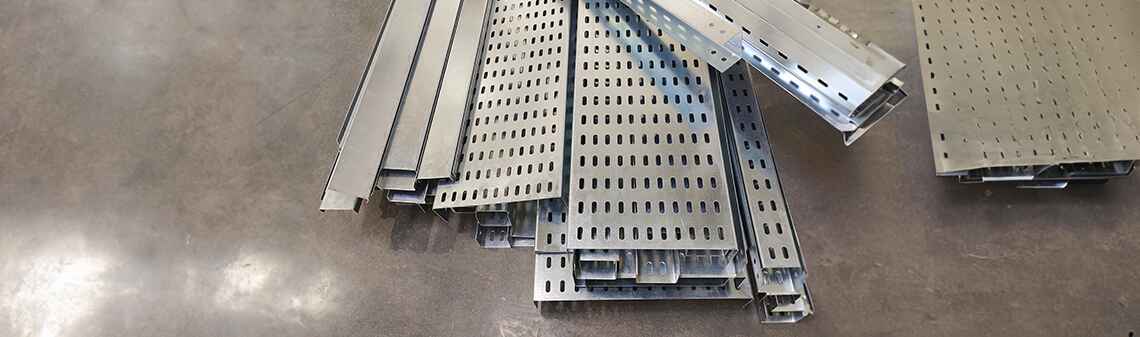
A perforated (ventilated trough) tray has a continuous base with holes or slots. It supports cables along their full length while still letting heat escape, so it suits mixed power and control cabling and smaller cables that need continuous support.
- Use it when: you want a balance of support, ventilation and cost in commercial and industrial buildings, workshops and power plants.
- Avoid it when: the route needs maximum ventilation for high-density data cabling (choose mesh) or very heavy long-span loads (choose ladder).
- Typical size: width 50–1000 mm, side height 25–150 mm, length 2.5–3 m.
Browse our perforated cable trays.
3. Wire Mesh Cable Tray (Basket Tray)
Wire mesh trays are made of welded steel wire. They are light, quick to install and easy to cut and shape on site, which makes them the usual choice for data centers, IT rooms and above-ceiling routes.
- Use it when: you route data, telecom or light control cables and expect frequent changes.
- Avoid it when: cables are heavy power cables or the route is exposed to corrosive conditions without a suitable finish.
- Typical size: width 50–600 mm, height 25–150 mm, length 2–3 m.
Explore wire mesh cable trays.
4. Solid Bottom Cable Tray
A solid bottom tray has an unperforated base with side rails. With a cover it protects cables from dust, debris and falling objects, and it can reduce EMI exposure for sensitive cables. It is not fully enclosed unless a cover is fitted, and its ventilation is limited, so cable derating must be considered.
- Use it when: you route fibre optic, low-voltage or control cables in dusty areas, cleanrooms or healthcare facilities.
- Avoid it when: heat dissipation is critical or cables need frequent access.
- Typical size: width 100–600 mm, height 25–100 mm, length 2.5–3 m.
Pair with covers and accessories for full protection.
5. Channel Cable Tray
Channel trays are compact U-shaped sections for small bundles of cables in limited space. They are typically used for branch runs and drops from a main tray.
- Use it when: the load is light and space is tight, such as small offices and branch circuits.
- Avoid it when: you need to carry large cable counts.
- Typical size: width 50–300 mm, height 25–50 mm, length 2–3 m.
See our utility channel support systems.
6. Single-Rail Cable Tray
A single-rail tray uses one central longitudinal rail with cross members, so cables rest on both sides and can be accessed from the side. It is a light-duty, low-cost option.
Cable Tray Types by Material and Finish
Construction (ladder, perforated, mesh) and material are separate choices. Any construction type can be made in different materials, and the environment usually decides which one you need.
| Material / finish | Key properties | Typical environment |
|---|---|---|
| Pre-galvanized (GI) | Economical, zinc-coated before forming | Indoor, dry commercial and industrial areas |
| Hot-dip galvanized (HDG) | Thicker zinc coating, longer corrosion life | Outdoor, humid and industrial areas |
| Powder-coated / epoxy | Colour and added surface protection | Visible indoor routes, mild outdoor |
| Stainless steel (SS 304 / 316) | High corrosion and chemical resistance | Chemical, pharma, food and beverage, marine |
| Aluminium | Lightweight, corrosion-resistant | Solar, coastal, weight-sensitive installations |
| FRP / GRP | Non-metallic, chemical-resistant | Highly corrosive plants, offshore |
Elcon trays are produced in three manufacturing units in Pune, Lucknow and Nagpur.
Cable Tray vs Raceway vs Conduit
A cable tray is an open support system. A raceway or cable duct is an enclosed pathway that shields cables from dust, moisture and mechanical damage, and conduit is a tube for individual cables or small groups. Use trays for high cable counts and easy access. Use raceways or conduit where cables need full enclosure, such as surface wiring in hospitals, labs and offices. Raceway is a separate product, not a type of cable tray.
Cable Tray Standards and Load Classes
Cable trays are commonly designed and tested to IEC 61537 (international) and NEMA VE 1 (metal tray construction and testing), with NEMA VE 2 covering installation practice. Galvanizing and coating requirements come from separate standards, such as IS 2629 / IS 4759.
Load capacity is stated as a working load (kg/m) at a given support span. Always choose a tray whose rated load at your planned span exceeds the total cable weight, with margin for future additions.
How to Choose the Right Type of Cable Tray?
- Calculate cable load. Add up cable weights per metre. Heavy power cables point to ladder or perforated.
- Check cable type. Data and fibre suit mesh or solid bottom, power suits ladder or perforated, and mixed cables need segregation.
- Assess heat. High-density runs need ventilated trays (ladder or mesh).
- Define the environment. Choose HDG, stainless steel, aluminium or FRP for outdoor, coastal or chemical areas.
- Plan access and changes. Frequent changes favour mesh or ladder.
- Set the budget. Mesh and perforated are usually cheaper than ladder or stainless, but total cost depends on span, load and finish.
Cable Tray Comparison: Ladder vs Perforated vs Wire Mesh vs Solid Bottom
| Criteria | Ladder | Perforated | Wire mesh | Solid bottom |
|---|---|---|---|---|
| Structure | Side rails with rungs | Base with perforations | Welded wire grid | Continuous base with side rails |
| Airflow | Excellent | Good | Very high | Poor |
| Cable support | Strong, spaced rungs | Continuous, medium to heavy | Light to medium | Continuous |
| Protection (dust, EMI) | Minimal | Partial | Minimal | Best (with cover) |
| Load capacity | Very high | Medium to high | Low to medium | High |
| Installation | Easy | Easy | Very easy | Moderate |
| Access for maintenance | High | Moderate | Very high | Low (when covered) |
| Relative cost | Moderate | Moderate | Low | Higher |
| Best suited for | Industrial power, long runs | Commercial and industrial power and control | IT, telecom, data centers | Sensitive cables, cleanrooms, healthcare |
Standard Cable Tray Sizes
| Type | Width | Side height | Length |
|---|---|---|---|
| Ladder | 150–1200 mm | 50–150 mm | 3–6 m |
| Perforated | 50–1000 mm | 25–150 mm | 2.5–3 m |
| Wire mesh | 50–600 mm | 25–150 mm | 2–3 m |
| Solid bottom | 100–600 mm | 25–100 mm | 2.5–3 m |
| Channel | 50–300 mm | 25–50 mm | 2–3 m |
| Stainless steel (any type) | 100–900 mm | 25–200 mm | 3–6 m |
| Aluminium (any type) | 100–1000 mm | 25–150 mm | 2.5–3 m |
Overall, cable tray widths range from about 50 mm to 1200 mm and side heights from 25 mm to 200 mm. Custom sizes are available. For sizing calculations, fill ratio and examples, read our cable tray sizing guide, or download the Elcon catalogue for the full size chart.
Cable Tray Installation Basics
- Support spacing: keep supports within the span used for the tray's rated load.
- Fill ratio: do not fill the tray completely. Leaving room for heat dissipation and future cables is common practice (often around 40–50%), but follow your project specification and applicable code.
- Segregation: separate power from data cables, or use a divider or separate trays.
- Earthing: bond tray sections continuously. See our earthing materials.
- Terminations: use correct cable glands and lugs at equipment ends.
- Heat exposure: near hot surfaces, consider heat insulators.
- Fittings: use bends, tees, reducers, couplers and covers designed for the tray series (cable tray accessories).
Conclusion
Match the construction type to the load and cable type, then match the material and finish to the environment. Ladder suits heavy power, perforated suits balanced mixed use, mesh suits data, and solid bottom suits protected routes. For help choosing, view our cable tray range, see our clients and gallery, or send an enquiry. Elcon Global is a cable tray manufacturer in India with units in Pune, Lucknow and Nagpur.
Frequently Asked Questions
1. What are the 3 main types of cable trays?
The three main types are ladder, perforated and wire mesh cable trays. Ladder handles heavy loads and long spans, perforated balances support with ventilation, and wire mesh suits light data cabling and easy changes.
2. What are the 6 types of cable trays?
The six construction types are ladder, perforated (ventilated trough), solid bottom, wire mesh (basket), channel and single-rail. Materials such as galvanized steel, stainless steel, aluminium and FRP are separate choices that apply to each type.
3. What is the difference between ladder and perforated cable trays?
A ladder tray has two rails with open rungs, giving maximum ventilation and strength for heavy cables. A perforated tray has a continuous base with holes, so it supports smaller cables along their full length while still allowing airflow.
4. Which cable tray is best for heavy-duty installations?
Ladder trays are generally preferred for heavy cables and long spans because they combine high load capacity with good heat dissipation. Always check the rated working load at your support span.
5. What is the standard cable tray size?
Standard widths range from about 50 mm to 1200 mm, side heights from 25 mm to 200 mm, and lengths from 2 m to 6 m depending on type. Common widths are 100, 150, 200, 300, 450 and 600 mm. See the cable tray sizing guide for calculations.
6. When should I use a solid bottom cable tray?
Use it where cables need protection from dust, debris or EMI, such as cleanrooms, telecom and healthcare areas. Fit a cover for full protection, and remember its limited ventilation may require cable derating.
7. Which cable tray types suit corrosive environments?
Stainless steel (SS 304/316), aluminium, hot-dip galvanized and FRP trays resist corrosion. Choose based on the chemicals, humidity, salt exposure and budget.
8. Is a raceway the same as a cable tray?
No. A cable tray is an open support system, while a raceway is an enclosed pathway that fully surrounds the cables.
9. Which cable tray is the most cost-effective?
Wire mesh and perforated trays are usually the most economical, but total cost depends on load, span, material and finish. Compare options for your project through an enquiry.
10. How do I choose the right cable tray?
Start with cable weight, cable type, heat and environment, then choose the construction type and finish. Follow the step-by-step guide above or contact our team.