
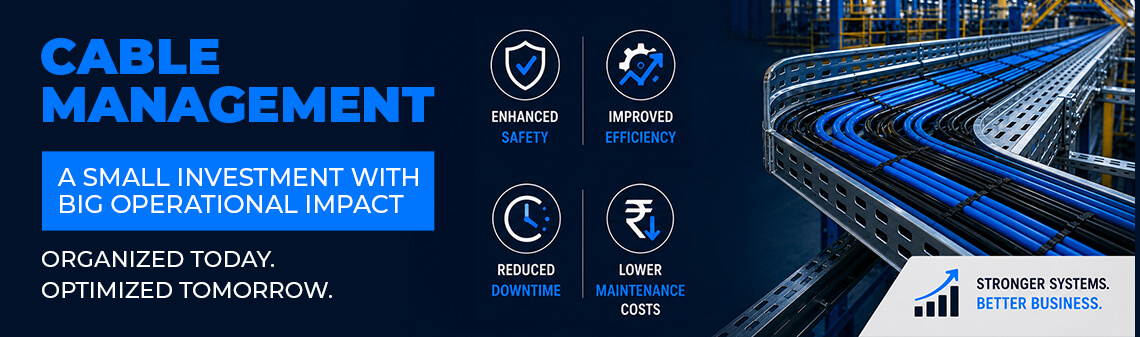
Cable Management: A Small Investment with Big Operational Impact
August 16, 2026In industrial facilities, warehouses, commercial buildings, and data centers, cables carry power, data, and communication signals. However, their organization is often overlooked during project planning. Poorly routed, unsupported, or unidentified cables can lead to maintenance challenges, limit future expansion, and increase operational risks.
A well-planned cable management strategy may take only a small part of the overall infrastructure budget, but its impact can be significant over the facility's life. Improving accessibility and supporting faster troubleshooting keeps operations safe, organized, and ready for growth.
What Is Cable Management?
Cable management involves routing, supporting, protecting, identifying, and maintaining electrical and communication cables. It may include cable trays, ladder trays, perforated trays, wire mesh trays, raceways, ducts, supports, glands, lugs, and accessories.
Cable tray systems support insulated electrical cables used for power distribution and communication. They offer a practical alternative to open wiring or conduit systems, especially when more cables may need installation later. Cable Organization Becomes an Operational Problem Disorganized cables may not seem critical during regular operations.
However, when equipment fails, production expands, or a new network connection is needed, a lack of structured electrical cable management can become costly.
Common problems include:
- Difficulty identifying the correct cable during repairs
- Longer shutdowns during maintenance or upgrades
- Restricted access to equipment and electrical panels
- Cable bending, crushing, or exposure to unsuitable conditions
- Congestion that complicates future expansion
- Increased housekeeping and inspection challenges
The real cost is not just an untidy installation. It's the added time, labor, and uncertainty created during every inspection, repair, and modification.
The Major Benefits of Cable Management:
1. Faster Maintenance and Troubleshooting -
Clearly routed and labeled cables allow technicians to trace connections more easily. This speeds up fault identification and reduces unnecessary disruption to nearby cables. Organized routing also enhances preventive maintenance. Teams can inspect cable conditions, supports, joints, and pathways before a minor issue causes unexpected downtime.
2. Better Protection for Cables -
Cables can be exposed to vibration, dust, moisture, heat, chemicals, or mechanical impact depending on the application. Good cable management solutions protect cable pathways and maintain the correct level of support. The choice of material, finish, load capacity, and tray type should match the operating environment. Elcon Global offers ladder, perforated, and wire mesh cable trays along with raceways, accessories, and support systems in various materials and finishes for different applications.
3. Improved Safety and Accessibility -
Loose or poorly placed cables can obstruct walkways, working areas, and equipment access. Structured routing keeps cables within defined pathways, making maintenance zones easier to navigate. Good industrial cable management also enhances visibility during inspections. When cable routes are consistent and easily accessible, damaged sections, loose supports, or overloaded pathways are easier to spot.
4. Reduced Downtime -
During a breakdown, every minute spent identifying and accessing the affected cable prolongs the disruption. A structured system helps technicians reach the correct connection faster and complete repairs with fewer interruptions. This is one of the key benefits of cable management: it turns cable organization into a practical factor for operational continuity.
5. Easier Expansion and Modification -
Facilities rarely stay the same. New machines, automation systems, sensors, storage equipment, and networking devices continuously increase cable needs. A flexible layout provides spare capacity, logical routing, and accessible pathways. Instead of rebuilding the entire installation, teams can add or replace cables more easily.
Cable trays are especially useful where changes are expected, as new cables can be laid within the tray rather than pulled through enclosed piping.
Factory Cable Management:
Effective factory cable management must consider machinery movement, vibration, changes in production, and environmental exposure. Power, control, and communication cables should be logically routed, supported at suitable intervals, and easily accessible for maintenance. The system should also provide enough capacity for new machines, automation upgrades, and future production needs.
| Facility | Main Requirement | Suitable Approach |
|---|---|---|
| Manufacturing plants | Power, control and instrumentation routing | Strong trays, separation of cable types and accessible maintenance paths |
| Warehouses | Long cable runs for lighting, automation and security | Scalable cable management systems for warehouses with clearly defined routes |
| Data centers | High-density power and network cabling | Separated pathways, airflow awareness and accurate identification |
| Commercial buildings | Power, communication and service flexibility | Concealed or structured raceways and trays |
| Infrastructure projects | Durability and long service life | Application-specific materials, finishes, supports and accessories |
Cable Management for Data Centers:
In data center infrastructure, cable density can increase rapidly as racks, servers, and networking equipment are added. Effective cable management for data centers helps separate power and data routes, makes cable identification easier, and prevents congestion from complicating maintenance or airflow planning. A structured layout also allows equipment to be added, replaced, or relocated without disturbing unrelated connections.
Practical Cable Management Tips:
The following cable management tips can enhance both new and existing installations:
- Plan cable routes before installing equipment.
- Separate power, data, and control cables as needed.
- Choose trays and supports based on cable load and environment.
- Avoid overcrowding pathways and allow capacity for future expansion.
- Use consistent labels at both ends of cables and at key junctions.
- Maintain a suitable bend radius and avoid causing stress on cables.
- Keep access points clear for inspection and repairs.
- Include cable pathways in regular preventive maintenance checks.
- Promptly replace damaged supports, covers, or accessories.
- Document modifications to keep cable records accurate.
Why Cable Management Should Be Viewed as an Investment?
The value of cable management goes beyond looks. It affects how quickly teams can respond to faults, how safely they can access systems, and how easily a facility can grow. A small investment in reliable trays, raceways, supports, and accessories can simplify maintenance for years. It also helps avoid future installations from becoming reactive, overcrowded, and costly. When the system is designed correctly from the start, it becomes a vital part of the facility’s long-term operational strategy.
Choose the Right Cable Management Partner:
Every application has different needs for load, ventilation, environment, material, and finish. Elcon Global manufactures cable trays and related systems for electrical, instrumentation, and mechanical uses. Its product range includes ladder trays, perforated trays, wire mesh trays, raceways, accessories, and adjustable support systems.
These products are used across sectors such as refineries, cement, power, IT, pharmaceuticals, automobiles, commercial facilities, metro and railways, textiles, and renewable energy. By implementing the right cable management solutions during the planning stage, businesses can create infrastructure that is easier to maintain, safer to operate, and better prepared for future growth. A small investment today can prevent major operational problems tomorrow.
FAQs:
1. Why is cable management important in industrial and commercial facilities?
It improves safety, accessibility, maintenance efficiency, and overall operational reliability.
2. What are the benefits of investing in cable management systems?
They reduce downtime, protect cables, simplify troubleshooting, and support future expansion.
3. What are the common cable management solutions?
Common solutions include cable trays, ladder trays, wire mesh trays, raceways, ducts, supports, glands, and accessories.
4. What industries benefit the most from cable management?
Manufacturing, warehouses, data centers, power, pharmaceuticals, railways, commercial buildings, and infrastructure sectors benefit significantly.
5. What should I consider when choosing a cable management system?
Consider cable load, operating environment, material, ventilation, accessibility, safety, and future expansion needs.